What does an OnlyFans chatter actually do? The job, shift by shift
An OnlyFans chatter writes a creator's direct messages and sells her content inside those chats. What the work involves, what a shift looks like, the tools, and who it suits — from an agency with 100+ chatters.
 ChatScale Team · 6 min read
The short version
- A chatter runs the inbox of a creator's OnlyFans account: they reply to fans in her voice, build rapport and sell locked content, tips and custom requests.
- It is text only. You never appear on camera, never use your own name and never create content.
- Most of the money is made in conversations, which is why agencies pay commission on what you sell.
- The conversations are adult. Writing skill, English and reliability matter more than experience.
- At ChatScale a shift is 8 fixed hours on Belgrade time, 6 or 7 days a week, coordinated on Discord.
An OnlyFans chatter is the person who writes a creator's direct messages. Big creators get thousands of messages a day and cannot answer them all themselves, so an agency's chatters run the inbox in her voice. They keep fans talking, build a connection and sell content inside the conversation. It is text only, and it is a sales job more than a chatting job.
We run the messaging on creator accounts from 10,000 to 350,000 fans, with over 100 chatters working remotely. What follows is the job as it actually works: what you do, what a shift looks like, what you use, and who it suits. We include the parts that put people off.
The job in one paragraph
Fans subscribe to a creator's page and message her. Every message is a chance to earn: a locked photo or video set (PPV, pay-per-view), a tip, a custom request, a renewal. The chatter's job is to answer each fan as the creator would, keep the conversation going, read what he wants and offer it at the right moment and price. Scripts and guidelines are provided. Knowing which line to send, and when, is the skill you are paid for.
That is why most agencies pay commission. On a large account the inbox earns far more than the subscription price, and the chatter is the person who turns a conversation into a sale.
What the work actually consists of
Every shift is made of the same five things, in roughly this order of importance.
- Reading the persona. Each creator has notes: how she writes, her humour, the emojis she uses, what she will and will not do, her content library and its prices. You write as her, so you study her first. A fan who has talked to her for months notices when the voice changes.
- Triage. Not every message is worth the same. Active conversations come first, then fans who have spent before, then new subscribers, then cold fans. Our system is built around the 80/20 rule: roughly a fifth of fans bring most of the revenue, and it helps you spot them quickly so your shift goes where the money is.
- Rapport. Nobody buys from a vending machine. You ask questions, remember details, tease, joke. Good chatters are curious about people and make each fan feel like the only one in the inbox.
- The sale. When the moment is right you offer something: a locked set, a bundle, a custom. You handle the objection ("too expensive", "send a preview first") without sounding desperate, and you know when to drop it and come back later.
- The hand-off. Shifts change, fans don't. You leave notes on the conversations that matter so the next chatter picks up mid-sentence instead of starting cold.
Here is a simplified example of the rhythm. The real thing is faster and messier, and on most accounts more explicit.
back from the gym finally 😮💨 long day
Chatter, as the creatorlook at you being disciplined 😏 legs or arms today? and don't lie
legs lol. can barely walk
poor thing 😂 ok then you deserve a reward for surviving leg day. I shot something yesterday I haven't sent anyone yet… want first look?
obviously
Three messages of rapport, then the offer, framed as something personal rather than a sales pitch. Most of the craft is in that turn. Our chatter glossary explains the vocabulary you will hear from day one.
A shift, hour by hour
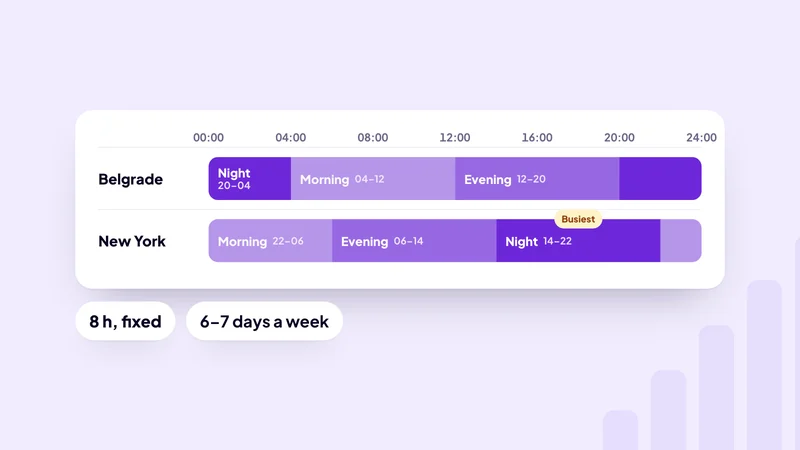
We run three fixed eight-hour shifts on Belgrade time (CET). They are fixed because fans are on US time and the inbox never sleeps. Here is how they line up with the US:
| Shift (Belgrade) | New York | Los Angeles | What the inbox is like |
|---|---|---|---|
| Morning 04:00–12:00 | 22:00–06:00 | 19:00–03:00 | US late evening into the night. Long, personal conversations with fans still awake. |
| Evening 12:00–20:00 | 06:00–14:00 | 03:00–11:00 | US morning and workday. Steadier, with Europe and the rest of the world mixed in. |
| Night 20:00–04:00 | 14:00–22:00 | 11:00–19:00 | US afternoon to prime time. Usually the busiest inbox. |
The US and Europe switch to and from daylight saving time on different dates, so for a few weeks in March and in late October or early November the gap shrinks by an hour. Your shift doesn't move. The fans do.
Inside a shift the structure is simple. You read the hand-off notes for your account, check who is online, and work the inbox in priority order. Your Team Lead is on Discord the whole time, and you write notes for the next chatter before you log off. You work 6 or 7 days a week: 6 is the minimum, and the seventh day earns a bonus.
The tools you'll use
- A chatting CRM. Agencies don't work in the plain OnlyFans app. They use software that shows each fan's spending history, notes, lists and the creator's content vault. Common names in the industry are Infloww, Supercreator and OnlyMonster. We use our own software, with scripts, sequences and hotkeys built in, so you are not typing everything from scratch.
- Discord. All our team communication runs there: your Team Lead, coaching sessions and shift channels. Help is one message away, at 2 a.m. too.
- A PC or laptop and stable internet. The job is done on a computer, not a phone. Our skills check asks for at least 4 Mbps download and 2 Mbps upload with a low ping.
What the job is not
- Not on camera. No video, no voice, no photos, no content creation. The creator makes the content; you sell it.
- Not under your own name. You never use your own name or personal social accounts with fans.
- Not customer support. You are measured on sales, and the people who do best treat it as a sales job.
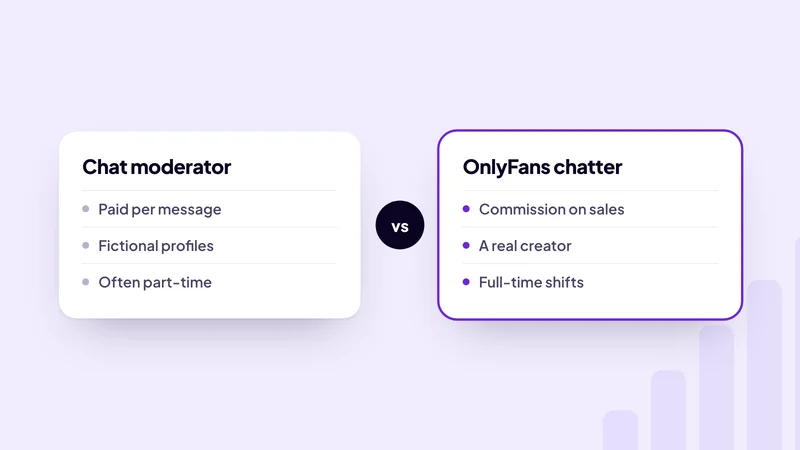
- Not a chat-moderator job. Moderators on flirt and dating platforms write as fictional profiles and are usually paid per message. It is a different industry with different pay. We compare the two here.
How explicit is it?
We'll be straight about it: the conversations are adult. On most accounts fans flirt, ask for explicit content and talk about their fantasies, and you answer in character. Some requests are odd. Some fans are lonely and just want to talk, and a few are rude.
The people who do well are not shocked easily, keep a professional distance, and see the work as writing and selling rather than something personal. If explicit text makes you freeze, this is the wrong job, and it is better to know before you apply than in your first week.
Who is good at it
Most people we hire have never done this before. The ones who succeed share a few traits more than a background:
- Quick with words. You can be funny, warm or teasing in writing, in English, at speed.
- Motivated by commission. Your income follows your results. If that excites you rather than scares you, good sign.
- Reliable. Fixed shifts mean the account depends on you being there on time, every day.
- Coachable. Your Team Lead reads your conversations every week. The fastest improvers are the ones who use that feedback.
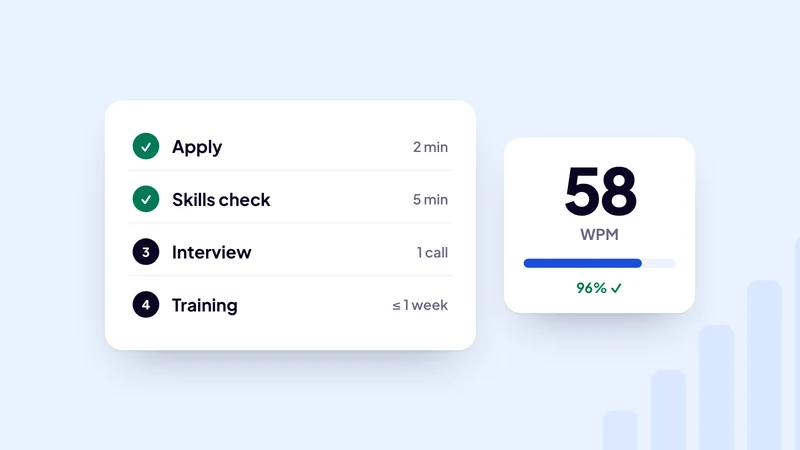
The hard requirements are short: written English at C1/C2, 50+ words per minute, a PC or laptop, full-time availability, and being 18 or older. Here is how hiring works, step by step.
How chatters are paid
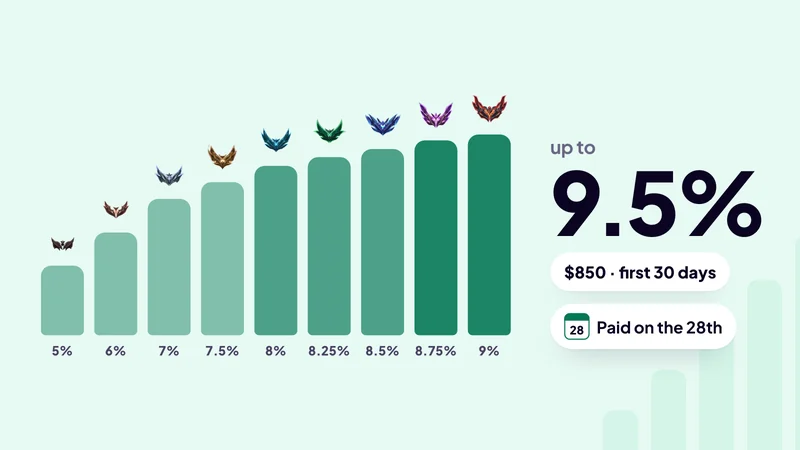
Pay models differ a lot between agencies, from a few dollars an hour to commission only with no floor. Ours is commission: you earn 5% to 9% of your sales depending on the size of the account you work, and a referral bonus adds 0.5% of a referred chatter's sales, so the ceiling is 9.5%. Your first 30 days are covered by an $850 guarantee, and you are paid on the 28th of every month. The full pay breakdown, with a calculator, is here.
Is it a real job?
It is, but the industry has bad actors. Some "agencies" charge training fees, pay commission only with no floor, or disappear after your first invoice. Before you join anyone, us included, read the 12 red flags we would check. A legitimate agency will be happy to answer every one of them in writing.
Questions people ask
Do OnlyFans chatters have to show their face or voice?
Is an OnlyFans chatter the same as a chat moderator?
Can men work as OnlyFans chatters?
How many fans does a chatter talk to at once?
Do I need experience to become a chatter?
Written by the ChatScale team — the team leads and trainers who hire, train and coach our 100+ remote chatters. Every figure about ChatScale in this article is one we stand behind in our contracts.