How to become an OnlyFans chatter with no experience
The requirements, the skills test, the interview and the training, step by step, with sample interview scenarios and the answers that get people hired. Written by the team that hires our chatters.
 ChatScale Team · 5 min read
The short version
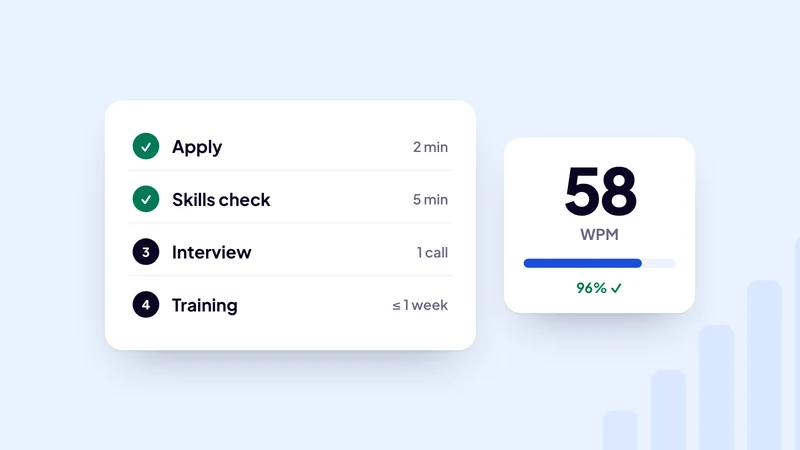
- You don't need experience. You need C1/C2 written English, 50+ WPM at 90% accuracy, a PC or laptop, stable internet, full-time availability and to be 18+.
- Hiring at ChatScale takes days, not weeks: a 2-minute application reviewed within 24 hours, a 5-minute skills check, a short interview, then training.
- Training is shadowing, then practice accounts, then a test shift. Experienced chatters can finish in one day, and beginners take up to a week.
- In interviews, agencies test how you handle real situations: a price objection, a request for free content, a fan who wants to meet. Stay in persona, stay warm, and steer back to the sale.
- The people who lose the job early do it through unreliability, not lack of talent.
You can become an OnlyFans chatter with no experience, and most people do. Agencies hire for a small set of things they can test quickly: written English, typing speed, reliability and whether you can sell in writing. They teach the rest. This guide walks through the requirements, the application, the skills test, the interview and training. It uses our own hiring process as the worked example and includes the interview scenarios that decide most applications.
The requirements
These are ours. Other serious agencies ask for something very similar.
| Requirement | What it means in practice |
|---|---|
| Age | 18 or older. No exceptions anywhere legitimate. |
| Written English, C1/C2 | Fluent, natural and casual. Fans can tell a textbook sentence from a real one. |
| Typing, 50+ WPM | At 90%+ accuracy. You keep several conversations going at once. |
| PC or laptop | The work is done in a desktop CRM, not on a phone. |
| Stable internet | At least 4 Mbps down, 2 Mbps up and a low ping. |
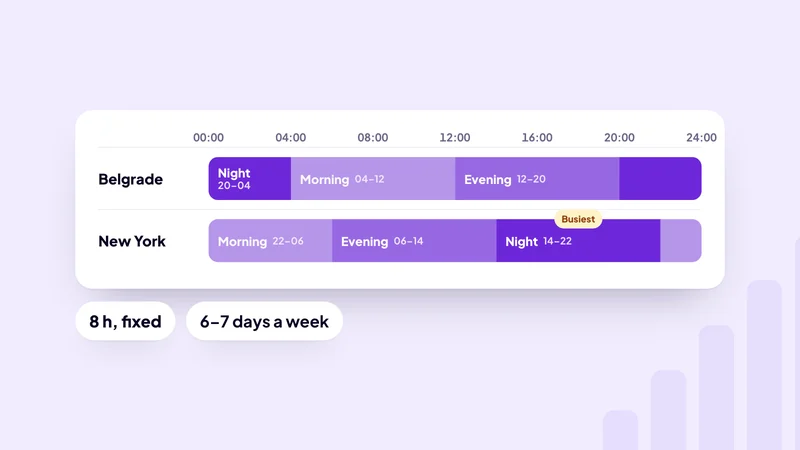
| Full-time availability | 8-hour fixed shifts, 6 days a week minimum. |
| Comfort with adult chat | The conversations are explicit. That needs to not throw you. |
What is not on the list: a degree, a CV, previous agency work, or a particular nationality or gender. We hire on work ethic, sales skill and reliability, not on a passport.
Step 1: Apply (2 minutes)
A good application form is short. Ours asks about your age, availability, equipment and English, and takes about two minutes. We review every application within 24 hours. If an agency wants money at this stage, for a "course", "slot" or "software", walk away. A legitimate agency never charges you to apply or to be trained. More red flags here.
Step 2: The skills check (5 minutes)
Most agencies test the same three things in some form. In ours, each part is timed and a failed requirement ends the application, so do it somewhere quiet on a computer.
- English, C level. Six quick questions, one attempt. They test whether you understand tone and natural phrasing, not grammar trivia.
- Internet speed. A quick connection test, up to three attempts. Close downloads and streams first.
- Typing speed. 25 seconds of copying a text exactly, up to three attempts. You need 50+ WPM at 90%+ accuracy.
How to prepare
- Typing: practise on free sites like Monkeytype or 10FastFingers for 15 minutes a day for a week. Accuracy first. Mistakes cost more than slowness.
- English: read casual, written English, such as group chats, comment sections and texting-heavy fiction, and notice the rhythm. Chatting English is short, warm and lowercase-friendly. It is not email English.
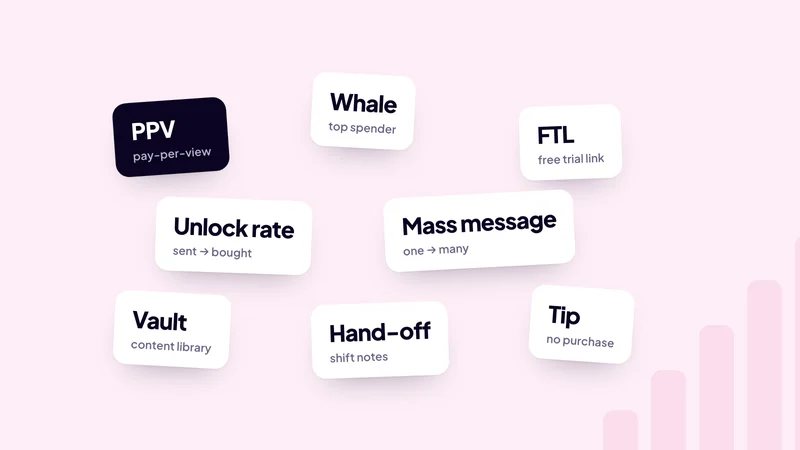
- Vocabulary: skim our chatter glossary so terms like PPV, whale or mass message don't trip you up in the interview.
Step 3: The interview
Ours is a short meet-and-greet, more a conversation than an exam, and it is the moment to ask us anything. Most agencies also check how you would handle real chat situations. Here are four that come up everywhere, with the kind of answer that sinks an application and the kind that gets people hired.
"Your prices are too high."
Weak: "ok I can do it for half 😊". Discounting straight away teaches the fan that every price is negotiable, and it halves your commission.
Strong: stay warm, add value instead of cutting price, and keep the door open. "haha I know it's not my cheapest one… but it's also not something I send to everyone 🙈 tell you what, I'll add a little extra in there just for you." The point is that you protect the price and keep the connection.
"Send me something for free first."
Weak: sending paid content for free, or a flat "no".
Strong: tease without giving the product away. A short playful line, then a reason the paid item is worth it. Fans who ask for free content are testing you, and confident, light-hearted answers sell better than either giving in or shutting down.
"Let's meet up" or "add me on Snapchat".
Weak: agreeing, or making promises about meeting.
Strong: decline kindly, in character, and bring the conversation back to the platform. You never move a fan off the account, never promise to meet, and never share contact details. Interviewers ask this to see whether you know where the line is.
A fan is rude or insulting.
Weak: arguing back, or taking it personally.
Strong: stay calm and in persona, set a light boundary, and decide quickly whether the conversation is worth your time. Your shift belongs to the fans who will buy. Knowing when to move on is part of the skill.
Interviewers are not looking for perfect lines. They want to see that you stay in character, protect the price, respect the platform's rules and don't get rattled.
Step 4: Onboarding and contract
After the interview you sign a contract. It exists to protect you: your commission, your payout date and your terms in writing. You will also be asked for the personal details any legitimate employer needs. Be wary of the opposite case, where an agency puts you on live accounts with no contract and no identity check. That is not a relaxed agency. It is one you will have trouble getting paid by.
Step 5: Training
Training at ChatScale has three stages, and you set the pace:
- Shadowing. You watch our best performers work live and see exactly how they sell.
- Training accounts. You practise on very small accounts, where mistakes are fine.
- Test shift. When you feel ready, you request it: 8 hours on an account without a live supervisor.
People with agency experience often finish in a single day. Beginners take up to a week, and that is completely fine. After that you get accounts matched to your skill. Our accounts range from 10,000 to 350,000 fans, and a strong start moves you up fast.
The mistakes that end chatter careers early
- Missing shifts or logging on late. The account depends on coverage, and nothing loses a chatter job faster.
- Robotic copy-paste. Scripts are a starting point. Fans notice when every message sounds the same.
- Slow replies. A warm fan cools down fast. Triage, so the right people get fast answers.
- Breaking platform rules. Moving fans off-platform, sharing account access or using restricted words gets accounts flagged and chatters removed.
- Ignoring feedback. Your Team Lead reads your conversations every week. The people who climb fastest act on what they hear.
Where to find chatter jobs, and how to choose
Chatter jobs are advertised on agency websites, specialist OnlyFans job boards, Telegram and Discord groups, Facebook groups and social media ads. Quality varies enormously. Before you pick one, compare the things that decide your month: the pay model and what commission is calculated on, whether there is a guaranteed floor while you learn, the payday, the contract, the shift times, and who you will actually be talking to when something goes wrong. Our salary guide shows what the pay models look like in numbers.
Questions people ask
Can I become an OnlyFans chatter with no experience?
What typing speed do OnlyFans chatters need?
What level of English do I need?
Can I do the job from my phone?
How long does it take to get hired?
Can I work part-time?
Written by the ChatScale team — the team leads and trainers who hire, train and coach our 100+ remote chatters. Every figure about ChatScale in this article is one we stand behind in our contracts.